091-774-6666
 @whospital


A Facelift Can't Fix Everything: Understanding the Difference Between "Sagging Skin" and "Volume"
When it comes to correcting a sagging, older-looking face, many people assume that getting aFacelift will completely solve every sign of aging on the face. In reality, facial aging isn’t one-dimensional. A facelift has clear strengths and a clear scope of what it can treat, so understanding the difference between concerns with theSkin,Volume Loss, andstructural sagging (Skin Laxity) is key before deciding on surgery.
This article helps you clearly tell these concerns apart, so you can choose the most targeted and cost-effective treatment under the safety standards ofW Plastic Surgery Hospital.
Telling Apart the 3 Main Facial Concerns: Skin, Volume, and Sagging
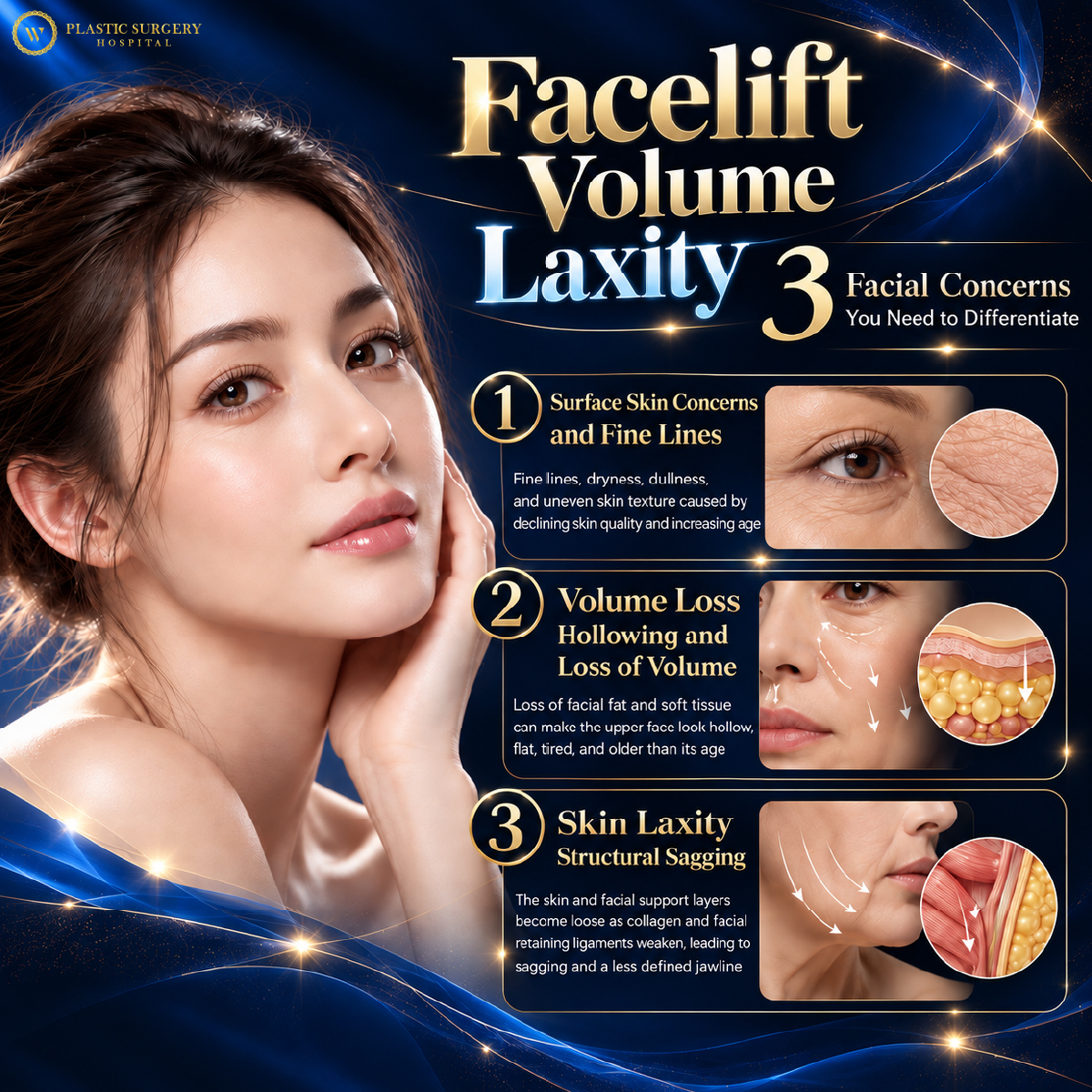
Signs of aging on the face come from changes in different structural layers, and each concern requires a different solution:
- Skin quality concerns (Skin Quality): These affect the outermost layer of skin and include dryness and roughness, marks, fine lines, uneven skin tone, or the loss of elasticity that comes with age. Restoring skin quality calls for skincare, lasers, or skin treatments.
- Volume loss (Volume Loss): This is caused by the shrinking of the deep layer of fat beneath the skin and the breakdown of bone mass, which makes once-full areas like the temples, under-eyes, and apples of the cheeks look hollow and sunken. A facelift alone can’t add volume to these sunken areas to make them full again.
- Structural sagging (Skin Laxity & SMAS): This is caused by the fascia, muscles, and facial retaining ligaments loosening with gravity, leading to sagging cheeks, a less defined jawline, and deep smile lines. This is the main target that aFacelift is designed to address.
Why Can't a Facelift Fix Everything?
Although a facelift is a highly effective procedure for lifting the internal structure (such as the SMAS layer), restoring a sharp jawline, and correcting sagging exceptionally well, there are some limitations you should understand:
H3: It Can’t Fill in Sunken Areas (Volume Loss)
If a patient also has hollow cheeks or sunken temples, tightening the skin will make the jawline firmer, but it may not restore fullness to the areas that have become hollow.
H3: It Can’t Correct Every Surface Skin Concern
Acne marks, melasma, freckles, dark spots, or fine lines on the surface of the skin are not things that facelift surgery can directly change.
For this reason, in many cases doctors recommend a combined approach, such as a facelift together with fat grafting (Structural Rejuvenation), to correct both sagging and volume loss at the same time.
How to Get the Right Assessment Before Deciding on Surgery
Choosing an anti-aging solution that doesn’t target the real problem can give you results that aren’t worth the cost. For example, if your concern is sagging but you choose large amounts of filler to try to lift your face, it can look unnaturally puffy. Or if your concern is hollowness but you choose a facelift alone, your face may still look tired.
Consulting a specialist surgeon for a detailed analysis of your facial proportions is therefore a first step you shouldn’t skip, so your doctor can assess whether your concern is mainly due to the skin, Volume Loss, or sagging.
Confidence in Results and Safety at W Plastic Surgery Hospital
At W Plastic Surgery Hospital, we place great importance on an honest, in-depth analysis of each patient’s concerns:
- Detailed structural assessment by specialist doctors: To tell your concerns apart and choose the most precise treatment, whether that’s a facelift, volume restoration, or the right combination of procedures.
- International hospital-level safety standards: Care is provided in sterile operating rooms with a full range of life-support equipment (such as vital-sign monitors and Dantrolene), with an anesthesiologist closely monitoring you 100% of the time throughout surgery.
- Long-term continuous care: Feel confident throughout your recovery with ourPost-Op Follow-up program, as our team of doctors and nurses closely monitors your progress.
Ask our team what a facelift can address.
FAQ: Frequently Asked Questions About Facelifts
Q1: How can I tell whether my facial concerns are caused by Volume Loss or Skin Laxity?
You can get an initial idea from what you see. If your face looks sunken and hollow in areas such as the temples, under-eyes, or cheeks, it’s usually due to Volume Loss. But if you have sagging cheeks, a less defined jawline, or a double chin, it’s usually due to Skin Laxity. That said, we recommend seeing a doctor for an accurate assessment of your facial structure.
Q2: If I get a facelift, do I also need fat grafting or another volume-restoring treatment?
It depends on each person’s concerns. If a patient has clear volume loss in the fat layer along with sagging, the doctor may consider doing both together, so the face looks firm and full as well as naturally youthful.
Q3: How well does a facelift correct deep smile lines?
Deep smile lines can be caused by both sagging tissue pulling downward and bone loss. A facelift is very effective at lifting the fascia that pulls on the smile lines, making them shallower, but in some cases volume restoration may also be needed to fully smooth them out.
Q4: Will my skin automatically look firmer after facelift surgery?
A facelift lifts sagging skin and muscle back into a firmer position, which reduces lines caused by sagging. However, it doesn’t change the quality of the outer layer of skin, so you should continue taking care of your skin alongside it for healthy-looking skin all around.
Q5: Why is an assessment by a specialist surgeon so important before surgery?
Because everyone’s signs of aging are complex and different. An assessment by a specialist doctor at W Plastic Surgery Hospital helps accurately identify the real cause, prevents unnecessary procedures, and ensures a treatment plan that delivers the most worthwhile and safest results.