091-774-6666
 @whospital


What Is Midface Aging? Why the Cheeks Are Key to a Youthful-Looking Face
As time goes by, many people notice changes in their face that give away their age, whether it’s deeper smile lines, hollow under-eyes, or once-full cheeks that have flattened out. All of these changes center on a process calledMidface Aging, the deterioration and sagging of the middle of the face, which is the most important sign that our face is starting to “look older.”
This article gives you an in-depth look at what causes changes in the midface, why the “cheeks” are what make or break a youthful look, and how to care for and correct these concerns in a targeted way under the hospital-level safety standards ofW Plastic Surgery Hospital.
What Is the Midface, and Why Is It the Most Important Area for a Youthful Look?
The structure of the human face is divided into 3 main parts: the upper face (Upper Face), the middle of the face (Midface), and the lower face (Lower Face).
TheMidface covers the area from under the eyes, through the apples of the cheeks and the cheekbones, down to the smile lines. In aesthetic medicine (Aesthetic Anatomy), the midface is regarded as“The Pillar of Youth” because it:
- Catches the light and creates dimension: Naturally full, lifted cheeks reflect light, making the face look more dimensional, radiant, and glowing.
- Serves as a support base for the surrounding structures: The apples of the cheeks act like a cushion that supports the skin around the eyes and smile lines and keeps it from sliding down with gravity.
- Is an accurate indicator of age: When the midface loses its firmness, the signs of aging show up most clearly, making you look tired and older than your age.
How Midface Aging Happens: What Happens to Our “Cheeks” with Age?
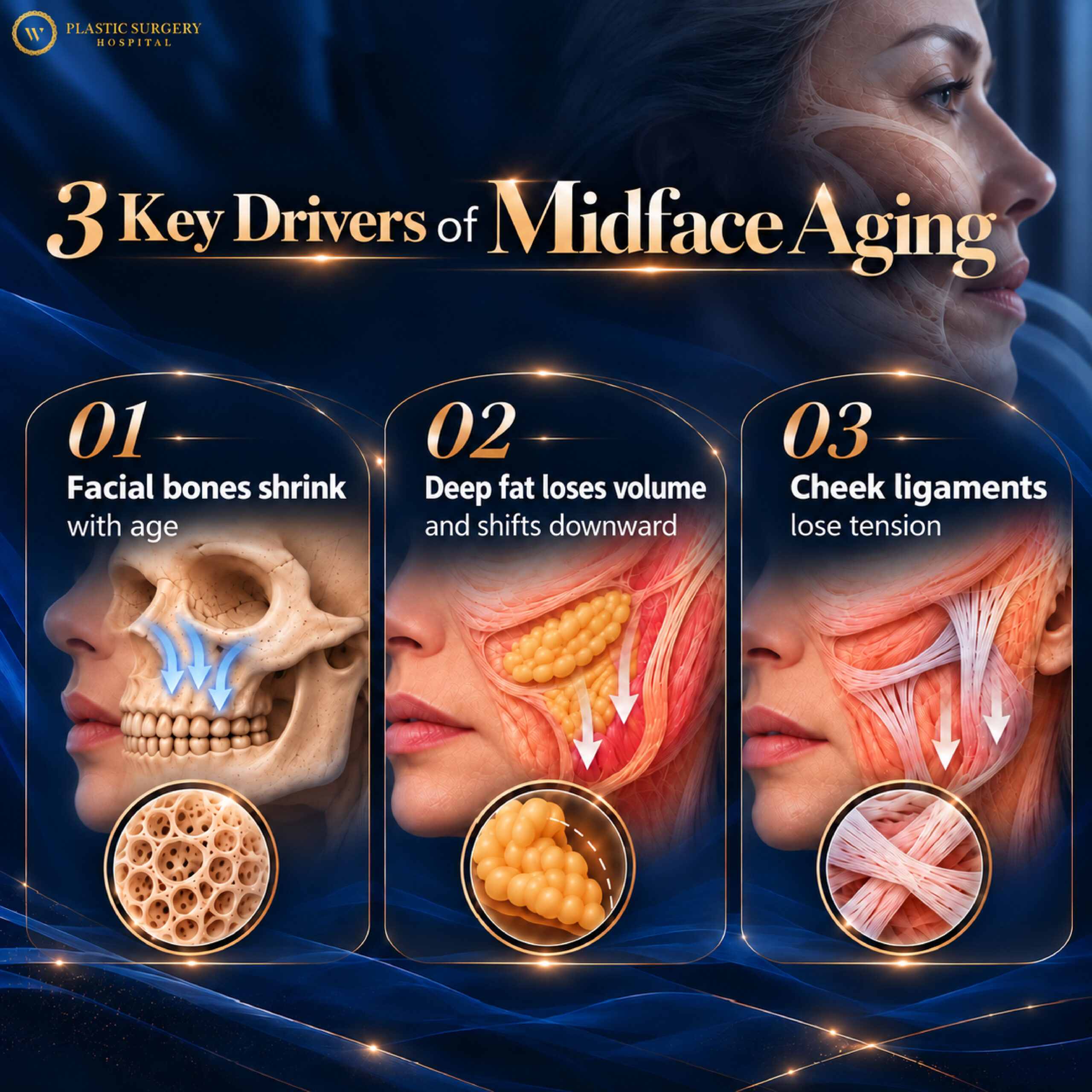
Midface Aging isn’t caused by sagging skin alone. It involves changes happening simultaneously across several structural layers (Facial Aging), including:
- Bone loss (Bone Resorption): With age, the eye sockets and cheekbones gradually break down and recede, taking away the base that once supported the tissue above. As a result, the areas under the eyes and in the cheeks sink in and become hollow.
- Shrinking and shifting of the deep fat pads (Deep Fat Pad Atrophy & Descent): The deep layer of fat beneath the skin that once kept the cheeks full starts to shrink and flatten, and some of it shifts downward with gravity, leading to deep smile lines and sagging cheeks.
- Loosening of the facial retaining ligaments (Retaining Ligaments Laxity): The ligaments that hold the cheeks in place against the bone begin to lose their tension, so the cheeks lose their anchor points and slide down, collecting around the smile lines and the corners of the mouth.
The Effects of Midface Aging You See in the Mirror
When the middle of the face begins to deteriorate (Midface Aging), it sets off a chain reaction that leads to the facial features patients most often worry about, including:
- Hollow under-eyes and prominent under-eye bags: Caused by the eye socket bones receding and the upper cheek fat sinking, which leaves the skin under the eyes looking hollow.
- Deep smile lines (Nasolabial Folds): Caused by sagging fat and tissue in the cheeks sliding down and piling up around the corners of the mouth.
- A flat, dull-looking face: A lack of fullness and dimension around the cheekbones makes the face look tired and lifeless.
How to Correct Midface Aging and Restore a Youthful Look
Correcting the signs of aging in the middle of the face requires an in-depth understanding of facial anatomy in order to choose the approach that best fits how severe the problem is.
H3: Volume Restoration (Volume Restoration)
For people with hollow cheeks or early-stage bone loss, fillers or fat injections can help restore fullness, but they must be done by an experienced doctor so the face doesn’t end up looking unnaturally puffy.
H3: Deep Structural Lifting (Deep Plane / SMAS Facelift)
For people with severely sagging cheeks, an advanced facelift technique that reaches deep into the fascia and the fat pads of the cheeks can lift the entire structural system back to its youthful position, with permanent and natural-looking results, without pulling on the outer layer of skin.
Why Is Midface Care Different at W Plastic Surgery Hospital?
Surgery or procedures on the middle of the face (Midface) are highly delicate because important nerves run through this area. Choosing W Plastic Surgery Hospital gives you the greatest peace of mind with:
- Precise facial assessment by specialist doctors: We analyze the real cause of your concern, whether it’s bone loss, fat atrophy, or sagging structures, in order to plan the most targeted treatment.
- International hospital-level safety standards: Every case is supported by sterile operating rooms and a full range of life-support equipment (such as vital-sign monitors and Dantrolene), with an anesthesiologist closely monitoring you 100% of the time throughout surgery.
- Natural-looking, youthful results: We focus on restoring a fresh, softer, more youthful look while fully preserving the features that make you uniquely you.
Talk to our team about hollow or sagging cheeks.
FAQ: Frequently Asked Questions About Midface Aging
Q1: At what age does midface aging start, and how can I spot it?
Midface aging can begin to develop and become clearly noticeable from around age 30–35 onward. The first signs usually include hollowing under the eyes, smile lines starting to show up, and the apples of the cheeks losing their fullness and no longer looking as firm as they did in your younger years.
Q2: Is filler alone enough to fix hollow cheeks and a sunken midface?
For early-stage concerns, filler or fat injections to fill in sunken areas (Volume Loss) can help a lot. But if the problem is caused by significant sagging of the muscles and facial retaining ligaments, adding volume with filler alone can make the face look too large or puffy, so lifting should be considered as well.
Q3: How does a midface lift (Midface Lift) help correct sagging cheeks?
A Midface Lift, or lifting of the middle of the face, is a technique that focuses on lifting the apples of the cheeks and repositioning sagging tissue over the cheekbones. It helps correct deep smile lines and restores fullness, giving the face a noticeably more youthful dimension.
Q4: Is there a risk to the facial nerves with midface surgery?
The facial nerves that control movement (Facial Nerve) run through the middle of the face, so this procedure should only be performed by a highly skilled specialist plastic surgeon with a precise understanding of facial anatomy. At W Plastic Surgery Hospital, it is performed by experienced doctors under the highest safety standards.
Q5: How should I take care of myself after a cheek-lifting procedure or surgery?
Follow your doctor’s instructions carefully, such as avoiding sleeping on your side at first, avoiding vigorous facial massage, avoiding alcohol and fermented foods, and attending your appointments in ourPost-Op Follow-up program so we can closely monitor your swelling and check how well your tissues are healing.