091-774-6666
 @whospital

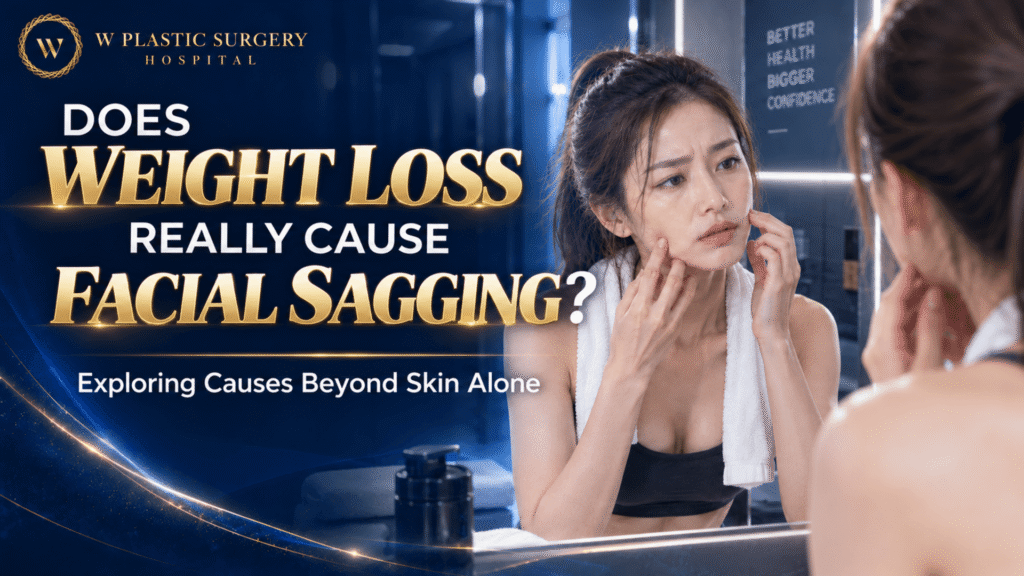
Does Losing Weight Really Make Your Face Sag? A Deep Dive into Why the Face Changes After Weight Loss, Beyond Just Loose Skin
Successfully losing weight and achieving a well-proportioned, healthy figure is a goal many people are proud of. But when they look in the mirror to see the changes, many are confronted with a new worry:“a sagging face, drooping cheeks, deeper nasolabial folds, a lost jawline, or a face that looks more worn than before.” Even though the body is slimmer, why does the face look older, moving in the opposite direction from the figure?
This is not just your imagination. Weight loss has a real impact on the deep structures of the face. This article walks you through the mechanisms at work, along with approaches for correcting the problem and restoring the skin for the long term.
Does Losing Weight Really Make Your Face Sag?
The answer is“yes.” The more weight you lose, or the faster you lose it, the higher the chance your face will sag.
When body weight drops, the body draws on fat stores throughout the body for energy. This fat is not found only in the belly or thighs; it also lies beneath the skin across the entire face. As soon as you lose weight, the fat in the face deflates, leaving skin that was once firm and taut without its support, and sagging follows.
Why Does the Face Change After Weight Loss? It Is Not Just Stretched Skin
The changes in the face are not caused solely by skin that cannot shrink back in time. They come from these four main structures:
1. Deflation of the Fat Beneath the Facial Skin (Facial Fat Pad Atrophy)
Beneath the facial skin are fat pads that act as“cushions of firmness,” pushing the skin outward so it looks full. When this fat deflates, the skin loses its supporting base, becoming hollow and drooping under gravity.
2. Laxity of the Retaining Ligaments (Retaining Ligament Laxity)
Beneath the skin are fibers and ligaments that act as anchoring pillars, holding the skin to the bone. When fat disappears and leaves empty space, these anchors lose their tension, so the tissue above slides down and gathers at the bottom.
3. Collagen and Elastin Cannot Be Produced Fast Enough
During strict dieting, the body may not receive enough nutrients to produce collagen. The skin loses its elasticity, lacks plumpness, and cannot shrink back to fit the new facial contours.
4. Age-Related Bone Loss Compounds the Problem
If you lose weight at age 30 or older, the problem becomes even more noticeable, because bone mass is already beginning to recede naturally. Combined with the loss of fat, the face looks even more sunken and hollow than before.
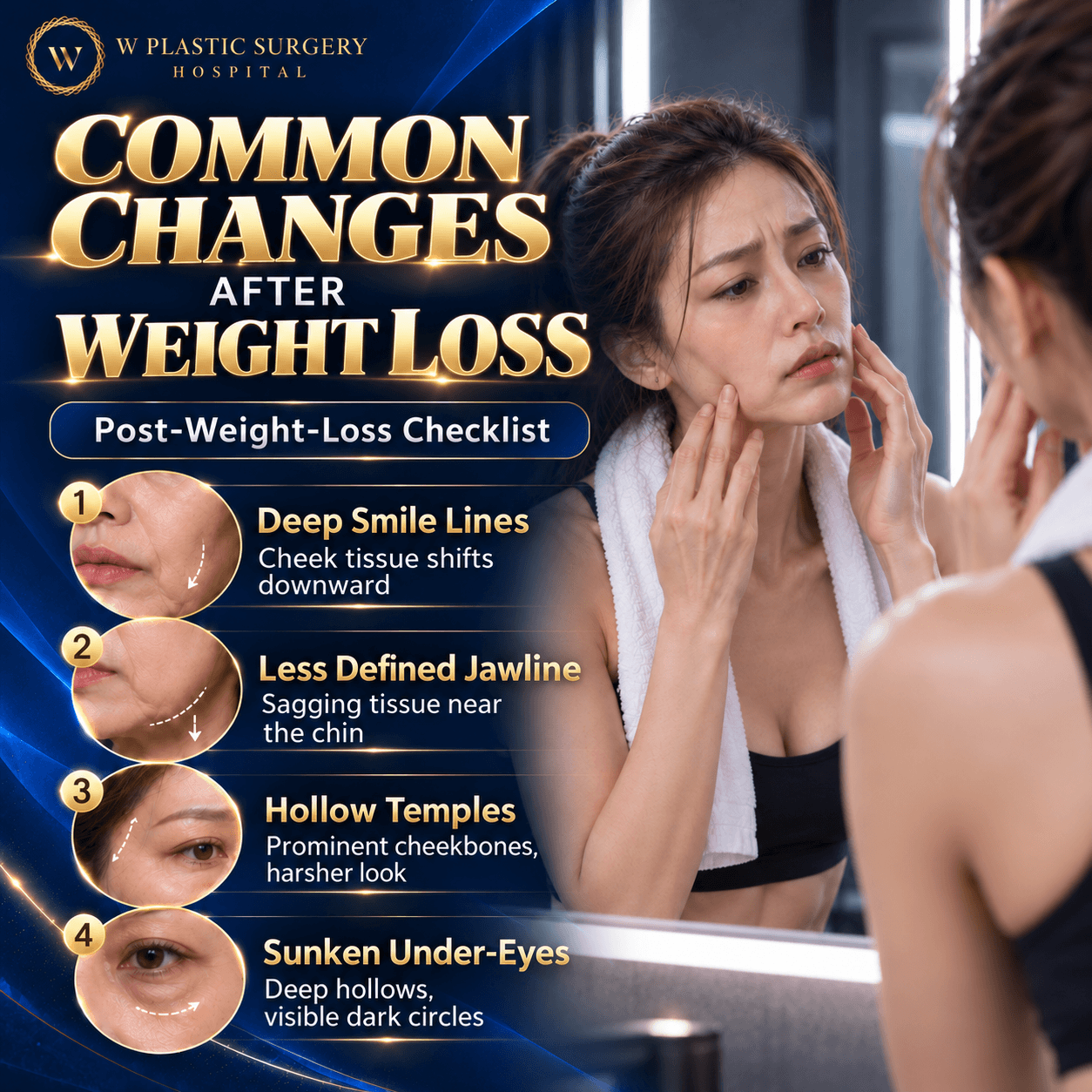
Common Signs of Change After Weight Loss
- Deeper Nasolabial Folds and Marionette Lines: The upper cheek tissue deflates and slides down to gather in the folds beside the nose and at the corners of the mouth.
- An Undefined Jawline with Jowls: The once-sharp jawline begins to be obscured by skin that sags down beside the chin.
- Sunken Temples and Prominent Cheekbones: Deflated temple fat makes the face look gaunt, and the cheekbones protrude, giving the face a harsher look.
- Hollow Under-Eyes: The loss of fat under the eyes makes the eye sockets look deep-set, and the thinner skin makes dark circles clearly visible.
Transform Your Face and Restore Firmness with Facelift and Facial Contouring Services at W Plastic Surgery Hospital
For those with significant facial sagging or drooping cheeks, creams may offer very little help. AtW Plastic Surgery Hospital, we are ready to care for you with premium surgical standards.
- Deep-Plane Facelift Technique (SMAS Facelift): Our specialist surgeons lift and tighten down to the SMAS muscle layer, repositioning the tissue where it belongs, with incisions discreetly hidden, for firm, natural-looking results without a tight, stiff, mask-like appearance.
- Hospital-Grade Safety Standards: High-standard sterile operating rooms, with a dedicated anesthesiologist providing 1:1 care throughout the surgery, and essential medications such asDantrolene stocked to handle emergencies.
- Comprehensive Care: Whether it is a facelift, Fat Grafting, or skin structure restoration, our medical team analyzes each case individually for the most harmonious and safest results, the choice trusted by celebrities.
Talk with our team about facial sagging after weight loss
Summary
Facial sagging after weight loss results from the loss of fat, retaining ligaments, and collagen. Understanding the true cause helps you choose the right method of care and restoration, bringing back your confidence and a fresh, youthful face to match your new, healthier figure.
FAQ: Frequently Asked Questions About Sagging After Weight Loss
Q1: If I regain the weight, will the sagging go away on its own?
Gaining weight may make the face look slightly fuller as fat returns, but if the skin has already stretched and lost its elasticity, gaining weight cannot restore the retaining ligaments to their former firmness, and it may even make the cheeks droop more than before.
Q2: Does age affect the severity of facial sagging after weight loss?
Very much so. People who lose weight at a young age still have better skin elasticity, so the skin shrinks back more easily. In people aged 35 and over, collagen has begun to decline naturally, so the face sags and hollows faster and more severely.
Q3: Can facelift surgery at W Plastic Surgery Hospital really fix sagging after weight loss?
A facelift using the SMAS technique addresses the root cause by tightening the deep muscle layer and trimming away excess skin, restoring a sharp jawline and permanently resolving drooping cheeks.
Q4: Does rapid weight loss cause more facial sagging than usual?
Absolutely. Losing weight too quickly causes the body to lose fat and muscle mass suddenly, and the skin cannot adapt in time, resulting in more pronounced sagging than with gradual weight loss.
Q5: After a procedure or facelift surgery, how long is the recovery before I can return to work?
Recovery time depends on the type of procedure. Energy-based lifting treatments require no downtime at all. With facelift surgery, there is swelling and bruising during the first week, and most patients settle in and can return to their normal routine within 2 weeks.
Q6: Besides sagging, does weight loss also increase wrinkles around the eyes?
Yes. The fat around and under the eyes can also decrease, resulting in deeper tear troughs and more pronounced lines around the eyes. This can be corrected in combination with fat grafting or filler to restore fullness.