091-774-6666
  @whospital
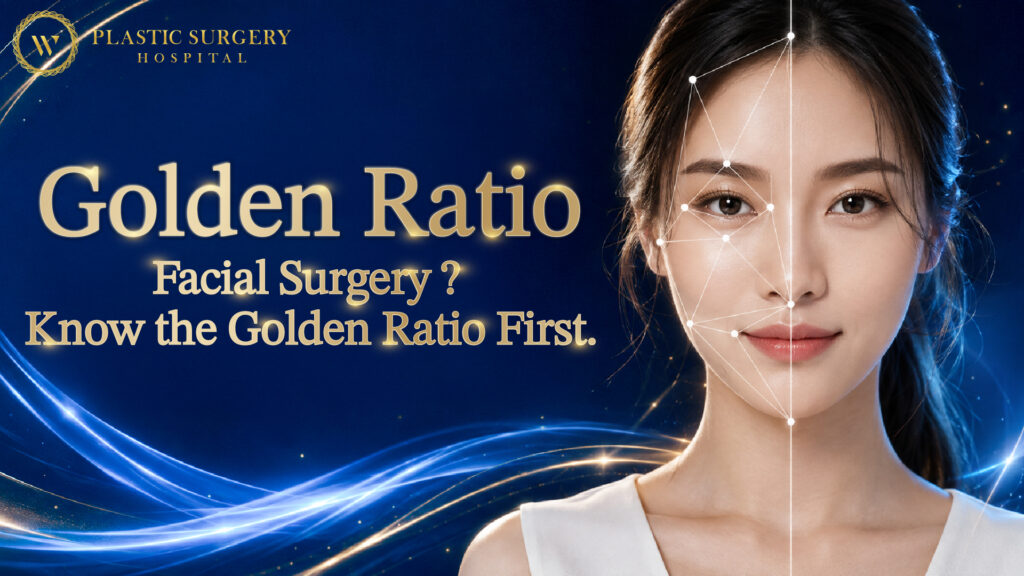
Why Should You Know About the Golden Ratio Before Deciding on Facial Surgery?
Many people who have studied beauty may have heard the term “Golden Ratio,” or the golden proportion, which has long been used as a reference standard for beauty. But in an era when the surgical field is placing more importance on natural-looking results and individual identity, an interesting question is whether this principle still has meaning in planning facial surgery today.
What Is the Golden Ratio?
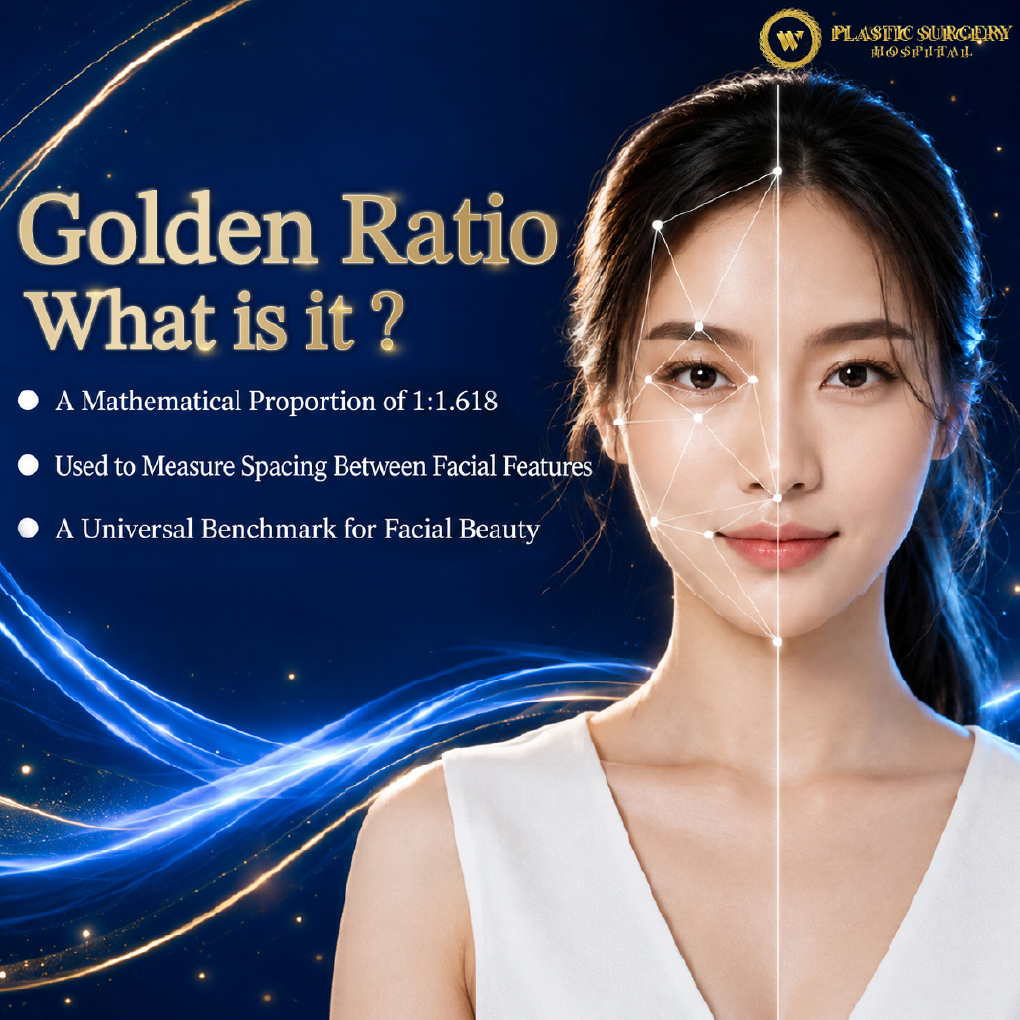
The Golden Ratio, or golden proportion, is a mathematical principle with an approximate value of 1:1.618. It has long been used to explain beauty in art, architecture, and the human face. In aesthetic medicine, this proportion is often used as a guideline for measuring distances between facial features, such as the distance between the eyes, the width of the nose compared with the width of the face, or the proportion between the upper and lower lips.
This concept was once used as an important reference framework in surgical planning because it was believed that faces with proportions closest to this value would be considered beautiful by universal standards.
Why Modern Surgery Does Not Rely on the Golden Ratio Alone
Although the Golden Ratio remains useful basic knowledge, in actual practice modern doctors generally no longer use this principle as the only deciding factor, for the following main reasons:
1. Real Human Faces Are Not Perfectly Symmetrical According to a Mathematical Formula
In reality, almost no human face has proportions that exactly match the Golden Ratio, even among people considered naturally beautiful. Trying to adjust a face strictly to fit this formula may therefore make the result look forced rather than more beautiful.
2. Beauty Has More Dimensions Than Numbers
Facial beauty does not depend only on numerical proportions. It also includes facial expressions, personality, and individual charm that numbers cannot measure. A face that does not exactly match the Golden Ratio can still look equally beautiful and attractive.
3. Facial Structure Differs Between Ethnic Groups
The Golden Ratio was developed mainly from studies of Western beauty, while Asian facial structures have different proportions. Applying the formula rigidly without adapting it to the specific structural characteristics of different population groups may produce a result that does not suit the actual face.
So Is the Golden Ratio Still Useful?
The answer is yes, it is still useful, but as a “reference guideline,” not a “fixed rule.” Modern doctors still use this principle as a starting point for an initial assessment of facial proportions, such as checking whether the proportion of one facial feature compared with another falls within a suitable range. However, it is not treated as the ultimate goal that must be matched exactly.
What doctors place greater importance on is combining this principle with:
The specific characteristics of each patient’s facial structure.
The patient’s needs and goals.
The principle of Facial Harmony, or the overall harmony of the face.
How W Plastic Surgery Hospital Uses the Golden Ratio in Surgical Planning
At W Plastic Surgery Hospital, we use the Golden Ratio only as one supporting tool for initial analysis, not as a fixed rule that must be achieved in every case. Our specialist medical team assesses overall facial proportions together with an understanding of Asian facial structure and each patient’s individual needs, in order to design a result that is both beautiful and fully preserves who you are, rather than forcing the face to fit any one mathematical formula.
For more information
FAQ: Frequently Asked Questions
Q1: Do doctors still use the Golden Ratio in surgical planning?
Yes, but only as an initial reference guideline rather than a fixed rule that must be matched exactly. Doctors combine it with an understanding of the individual facial structure and the principle of overall facial harmony.
Q2: If a face does not match the Golden Ratio, does that mean it is not beautiful?
No. In reality, most faces do not match this proportion exactly but can still look beautiful and attractive. Beauty includes more than numbers alone, such as facial expressions and individual personality.
Q3: Is the Golden Ratio suitable for Asian faces?
The Golden Ratio was developed mainly from studies of Western beauty, so it may not correspond to all aspects of Asian facial structure. Doctors therefore often adapt the principle together with an understanding of the specific characteristics of Asian faces.
Q4: Does using the Golden Ratio make surgery safer?
The Golden Ratio is a tool that helps with initial assessment of proportions, but surgical safety depends more on hospital standards, the doctor’s expertise, and the technique used. It is not directly related to this proportion principle.
Q5: Should I ask the doctor about the Golden Ratio during a consultation?
You can ask if you are interested in understanding your own facial proportions. However, what is more important is communicating your real needs to the doctor so that the result is both beautiful and still preserves who you are.