091-774-6666
 @whospital


What Causes a Sunken Face After Weight Loss? A Deep Dive into Facial Volume Loss and How to Restore Fullness Safely and Naturally
Successfully losing weight and achieving a well-proportioned figure is a goal many people are delighted to reach. But an unexpected side effect that causes a great deal of concern for many is“a sunken face, hollow cheeks, deep temples, or a face that looks noticeably gaunt and worn.” Many people find that even though their body looks better, their face appears aged, older than their years, or constantly tired, and their confidence begins to fade.
Why does weight loss affect the structure of the face this much? What is the phenomenon known asVolume Loss, the loss of volume beneath the skin? And if you want to restore youthfulness and bring back a full, radiant face, how do you choose the right method of facial volume restoration, one that does not look tight or stiff and remains safe in the long term? This article brings together every in-depth answer for you.
Why Does the Face Become “Sunken” After Weight Loss? A Deep Dive into Anatomy and Volume Loss
Many people mistakenly believe that when we lose weight, the body draws first on excess fat around the abdomen, hips, or thighs. In terms of anatomy, however, the“facial fat pads” are among the areas that respond most rapidly to fat breakdown.
When body weight drops, the structural layers beneath the skin enter a state known asVolume Loss (the loss of facial volume), which results from three main factors occurring at the same time:
1. Shrinkage of the Facial Fat Layer (Facial Fat Pad Atrophy)
Facial fat is not a single sheet. It is divided into“deep fat pads,” which serve as the supporting foundation of the facial structure, and“superficial fat pads,” which give softness to facial expressions. When weight is lost, both of these layers shrink rapidly, causing the foundation that supports the skin to lose density, so the face immediately looks sunken and deflated.
2. The Skin and Retaining Ligaments Cannot Adapt in Time (Laxity of Retaining Ligaments)
Beneath our skin areretaining ligaments that act like anchoring pillars holding the skin layers to the bony framework. When the volume of fat beneath the skin disappears rapidly while the outer skin remains just as stretched, the skin begins to sag under gravity, making the deep grooves on the face even more visible.
3. Depletion of Collagen and Elastin (Collagen & Elastin Depletion)
During strict dieting or rapid weight loss, the body may not receive enough protein, vitamins, and minerals, which disrupts the collagen production process. As a result, the various layers of the skin lose elasticity, the skin looks dry and rough, lacks plumpness, and develops fine lines more easily than usual.
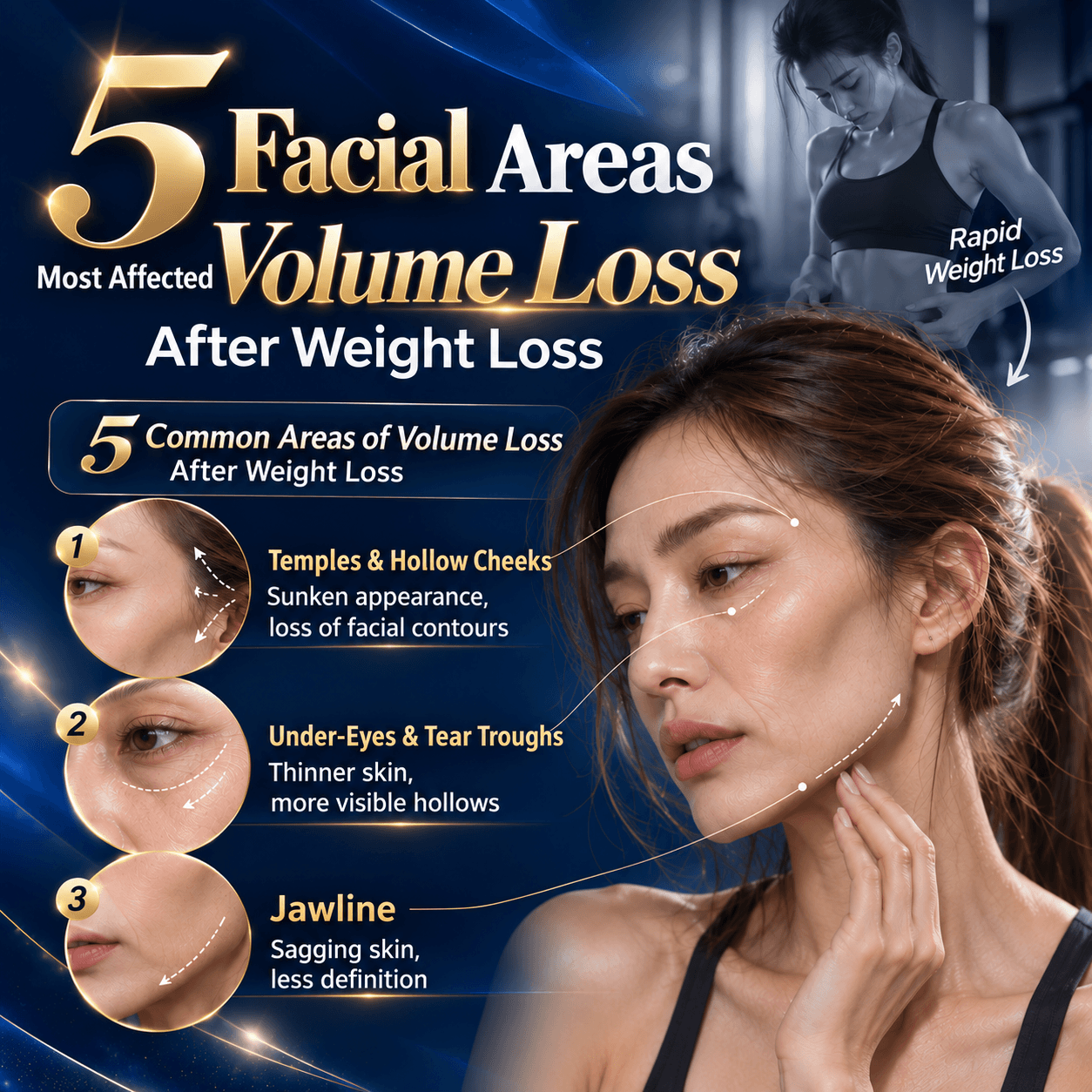
The 5 Areas of the Face Most Prone to Volume Loss After Weight Loss
When Volume Loss occurs, the body shows clear signs of change in five main areas of the face:
- The Temples (Temporal Fossa): Temples that were once full sink into hollows or deep depressions, making the cheekbones look overly prominent, so the face appears harsh, less radiant, and noticeably older.
- Hollow Cheeks and the Area Below the Cheekbones (Submalar Sunken Cheeks): When the mid-face fat disappears, the cheeks sink into visible hollows, making the cheekbones look steep and the face appear gaunt and sickly.
- The Under-Eye Area and Tear Troughs (Tear Trough & Infraorbital Rim): The fat under the eyes acts as a cushion supporting the skin. As it diminishes, the skin under the eyes thins until wide dark circles become visible and deep tear troughs form, giving a perpetually tired look.
- Nasolabial Folds and Marionette Lines (Nasolabial Folds & Marionette Lines): These result from the upper cheek fat sliding downward due to the lack of underlying support, making the folds beside the nose and at the corners of the mouth look deeper.
- The Jawline and Lower Face (Jowl & Jawline Deficits): Tissue along the jaw sags down over the jawline, blurring the facial contour and creating jowls beside the chin.
A Deep Dive into Facial Volume Restoration Options: Fat Grafting vs Filler vs Biostimulator
Correcting a sunken face after weight lossis not simply a matter of injecting any substance to fill it up. It is about “restoring volume naturally and in proportion” (Anatomical Volume Restoration). A specialist physician evaluates each individual’s underlying cause and skin structure and draws on three main innovations:
1. Autologous Fat Grafting (Autologous Fat Grafting / Micro-Fat Injection)
Excess fat is harvested from the patient’s own body (such as the abdomen, thighs, or hips), then processed through centrifugation and purification to obtainhigh-quality fat cells (Micro-fat / Nano-fat), which are then injected back into the face to restore volume.
- Key Advantages: It is a 100% biological material from your own body, so there is no risk of allergy or rejection. Once the fat cells take (Fat Survival Rate), they become a permanent part of the skin layers and can last for many years.
- Best Suited For: Those with widespread Volume Loss across the entire face, or those who want to reshape several areas of the face at once in a cost-effective way.
- Limitations: Requires recovery time from the liposuction, and the amount of fat that takes depends on each person’s physical condition and self-care.
2. Hyaluronic Acid Filler
Hyaluronic Acid (HA), synthesized to closely resemble the substance naturally found in the body, is injected to precisely fill deep grooves or specific areas where the bone and fat have receded.
- Key Advantages: Results are visible immediately after treatment with no downtime. The flexibility and density of the filler can be selected to suit each skin layer, and if you are unhappy with the result, it can be dissolved immediately with an enzyme injection.
- Best Suited For: Those who want to correct specific areas, such as sunken temples, deep nasolabial folds, or tear troughs, and those who have no time for recovery.
- Limitations: The filler gradually breaks down naturally within 6–24 months, so repeat injections are needed to maintain results.
3. Regenerative Biostimulator Injections
A medical innovation that uses safe synthetic particles injected into the skin layers to stimulate the body’s own fibroblasts to accelerate the production of new collagen.
- Key Advantages: Rather than adding volume from an external substance, it restores density and youthful structure to the skin from within. The results are soft and natural-looking, and it helps lift and firm sagging skin so it looks fuller and tighter.
- Best Suited For: Those with thin skin, sagging skin, or a loss of elasticity along with a sunken face, who want gradual but long-lasting results of 1–2 years.
- Limitations: Results are not immediate as they are with filler. You must wait approximately 1–3 months after treatment for the body to produce collagen.
Comparison Table: Analyzing the Options for Correcting Volume Loss
| Feature | Autologous Fat Grafting | HA Filler | Biostimulator |
|---|---|---|---|
|
Source |
Fat cells from your own body |
Synthetic hyaluronic acid |
Particles that stimulate skin cells |
|
Time to See Results |
Immediate, with full settling in 1–3 months |
Clear results immediately after treatment |
Gradually visible within 1–3 months |
|
Longevity of Results |
Partially permanent (the fat that takes lasts for many years) |
6–24 months (breaks down naturally) |
1–2 years (depending on the type of product) |
|
Recovery |
5–7 days of downtime (swelling/bruising) |
No downtime; normal activities can resume |
No downtime, or mild swelling for 1–2 days |
|
Suitability |
Best for large-volume restoration across the entire face |
Best for refining specific details |
Best for restoring skin quality and lifting/firming |
Precautions and Preparation Before Deciding on Facial Volume Restoration After Weight Loss
- Stabilize Your Weight First: Maintain a stable weight for at least3–6 months before undergoing surgery or any procedure. If your weight continues to drop, the fat or substance that was added may shift position or look disproportionate.
- Have Your Facial Structure Evaluated by a Specialist Physician: Facial volume restoration requires both anatomical science and the art of facial design. The physician must understand the fat layers, bone mass, and muscle alignment to calculate the precise volume to add.
- Verify the Safety Standards of the Facility: Whether you choose fat grafting, filler, or biostimulators, the procedure must be performed in an accredited hospital or clinic with a sterile operating room equipped with a HEPA Filter system, using genuine products and equipment.
W Plastic Surgery Hospital Evaluates First, Then Recommends the Right Approach
At W Plastic Surgery Hospital, we understand that each patient has a different cause of sagging. Before recommending any procedure, our team of specialist physicians always evaluates the facial structure in detail
to determine whether the main problem stems from fat loss, muscle laxity, or a combination of both, and then plans the most targeted approach, whether that is Filler injections alone or considering a facelift as well in cases of significant sagging, so you achieve the most worthwhile and natural-looking results.
Talk with our team about restoring facial volume
FAQ: Frequently Asked Questions About Correcting a Sunken Face
Q1: Fat grafting vs. filler for a sunken face: which is more cost-effective?
It depends on the size of the problem area and your needs. If you want to correct multiple areas across the face, autologous fat grafting is highly cost-effective in the long run. If you want to correct specific areas, such as sunken temples or deep nasolabial folds, filler is more convenient and allows more precise shaping.
Q2: Can a face that has become sunken from weight loss regain its fullness on its own?
If you regain your previous weight, some of the facial fat may return. However, for those who have been losing weight over a long period, or those aged 30 and over whose skin collagen has already declined, the skin and fat usually cannot recover their former fullness. Medical procedures are therefore the most targeted solution.
Q3: With facial fat grafting, is there a chance that all of the fat will be absorbed?
Normally, a portion of the grafted fat is absorbed during the first 1–3 months (approximately 30–50%, depending on the individual). However, the fat cells that survive and develop a blood supply become permanent tissue in the face and last for many years.
Q4: How should I prepare before undergoing facial volume restoration after weight loss?
Avoid anticoagulant medications, vitamin E, fish oil, and certain herbal supplements for at least 1–2 weeks before the procedure. Get enough rest, refrain from alcohol and smoking, and prepare your detailed health history to share with your physician.