091-774-6666
  @whospital
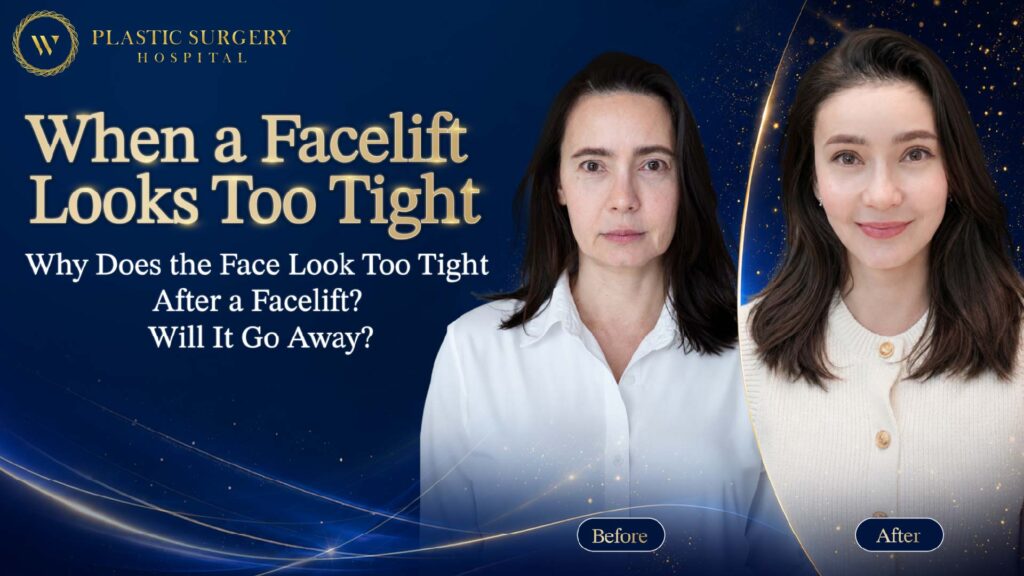
Face Too Tight After a Facelift — What Causes It? Will It Go Away?
One of the fears most patients have before deciding to have a facelift is that the result will look “too tight,” making the face look stiff, lifeless, and the smile unnatural. This problem does not happen without a cause. It has clear causes and can be prevented from the surgical-planning stage. This article will explain why the face can become too tight and what Natural Movement of the face means.
What Causes the Face to Look Too Tight After a Facelift?
An unnaturally tight appearance after a facelift is not caused by bad luck. It often comes from unsuitable technique and planning, as follows:
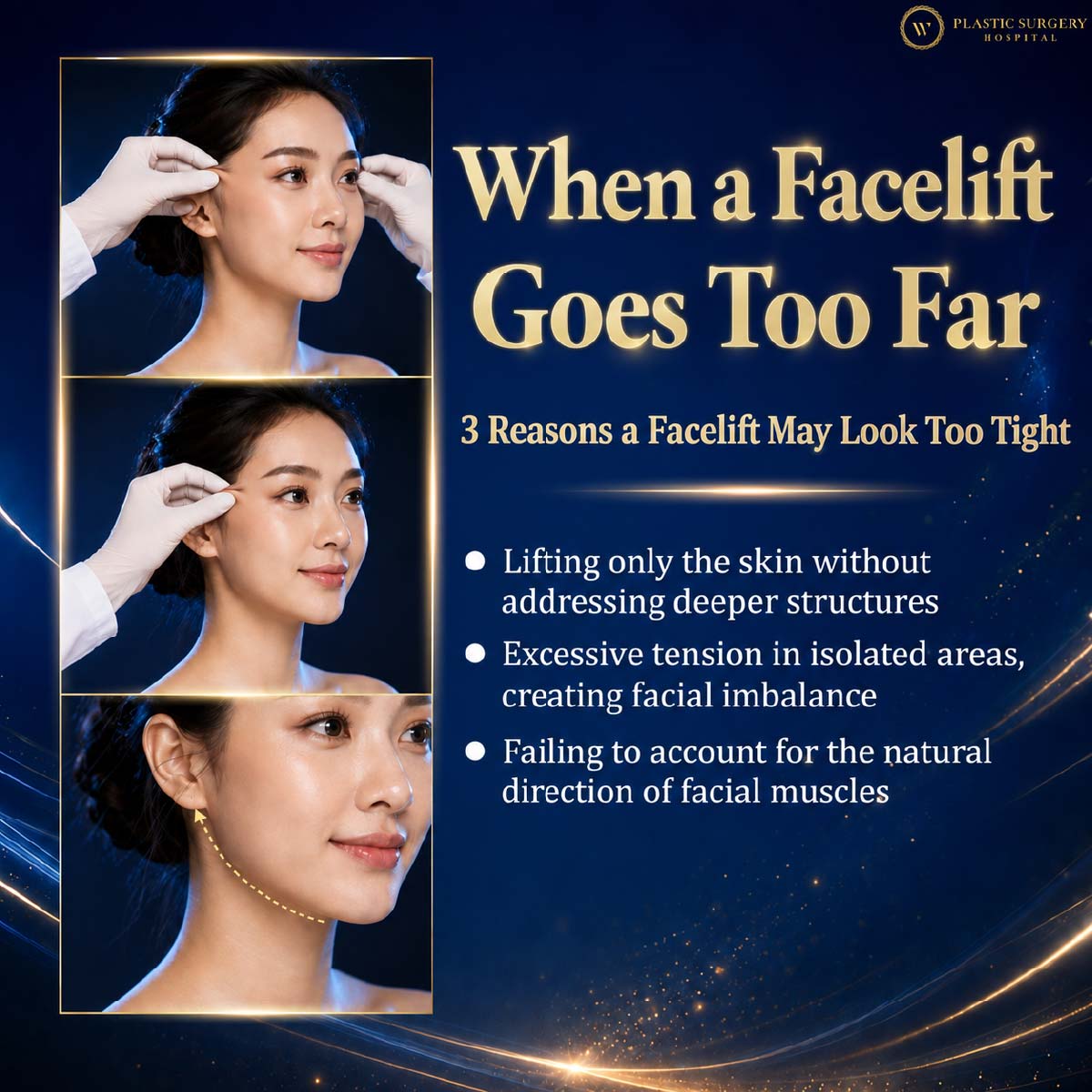
1. Pulling Only the Skin Without Correcting the Internal Structure
Some traditional facelift techniques focus only on pulling the skin tight without correcting the muscle layer or the fascia beneath the skin. When the skin is pulled too tightly while the internal structure remains sagging, the result is a face that looks unnaturally tight rather than truly firm.
2. Pulling Too Much in One Area
In some cases, one particular area such as the temple or cheek may be pulled too strongly without considering the balance of the whole face. This can cause what is called a “wind-blown face,” where the eyes or corners of the mouth are pulled until their shape changes from the original.
3. Not Considering the Direction of the Facial Muscles
The face has many muscles that work together when smiling, speaking, or making expressions. If a facelift is performed without considering the natural direction in which these muscles work, facial movement may become distorted. The face may look good while still, but immediately look forced when smiling or speaking.
What Is Natural Movement of the Face?
Natural Movement is a principle that gives importance to facial movement after surgery, not only to appearance while the face is still. Our faces are not still all the time. They are constantly moving when we smile, speak, or express different emotions. A good facelift therefore has to take these things into account from the planning stage so that the result looks good both when the face is still and when it is moving.
The key elements of Natural Movement are as follows:
- Able to smile fully:The corners of the mouth and the cheeks can still lift naturally and are not pulled so tightly that movement becomes difficult.
- Able to open and close the eyes normally:There is no drooping of the eyes or inability to open them fully because the pull was too strong.
- Able to make a range of expressions: Whether smiling, speaking, or looking surprised, the face can still move freely as it did before surgery.
How Does W Plastic Surgery Hospital Prevent the Problem of an Overly Tight Face?
Achieving a firmer result while preserving Natural Movement requires technique and a detailed understanding of facial structure, which is something our medical team gives importance to at every stage.
1. Correct Mainly at the Muscle Layer (SMAS)
Instead of pulling the skin tight, we focus first on correcting the muscle layer (SMAS) and the fascia beneath the skin, so that firmness truly comes from the internal structure. The skin therefore does not need to be pulled excessively tight.
2. Plan the Lifting Force to Be Balanced Across the Whole Face
The doctor will carefully assess each person’s areas of sagging and distribute the lifting force appropriately across each area, without pulling one area too strongly, in order to prevent a wind-blown appearance or changes in eye shape.
3. Assess Facial Movement During Planning
Before deciding on the surgical approach, the doctor will consider each patient’s natural facial movements, such as the angle of the smile and the direction of the muscles, in order to design a result that preserves a natural appearance rather than merely looking good when the face is still.
Because a Good Facelift Must Look Good Both When Still and When Moving
True firmness should not come at the cost of losing the natural movement of the face. At W Plastic Surgery Hospital, we understand the principle of Natural Movement well and apply it when planning every surgical case, so that you receive both the firmness you want and a face that can still smile, speak, and express emotions naturally as before.
For more information
FAQ: Frequently Asked Questions
Q1: If the face is too tight after a facelift, can it be corrected?
It depends on the cause and severity of each case. In some cases, it may be necessary to wait for the result to settle first, or additional correction by a specialist may be needed. It is recommended to consult a doctor to assess the approach suitable for each case.
Q2: How can I know whether the doctor I choose understands Natural Movement?
You should observe whether the doctor gives importance to discussing facial movement rather than only appearance while the face is still, and whether the treatment plan is explained with consideration of each person’s specific areas of sagging rather than using the same method in every case.
Q3: How is an SMAS facelift different from a traditional facelift?
An SMAS facelift corrects the muscle layer and structures beneath the skin, so that firmness truly comes from inside. This differs from a traditional facelift, which often focuses on pulling only the skin and therefore carries a greater risk of making the face look unnaturally tight.
Q4: How should I care for myself after a facelift that emphasizes Natural Movement?
You should follow the doctor’s instructions strictly, such as avoiding forceful facial movements during the early period and attending follow-up appointments, so that the wounds heal well and the result looks as natural as possible.
Q5: Is tightness during the early period after surgery abnormal?
A small amount of tightness during the first week after surgery is considered normal because swelling is still present and the wound has not yet fully healed. This feeling will gradually improve over time. If you are concerned, you should consult the doctor who is caring for you directly.