091-774-6666
 @whospital

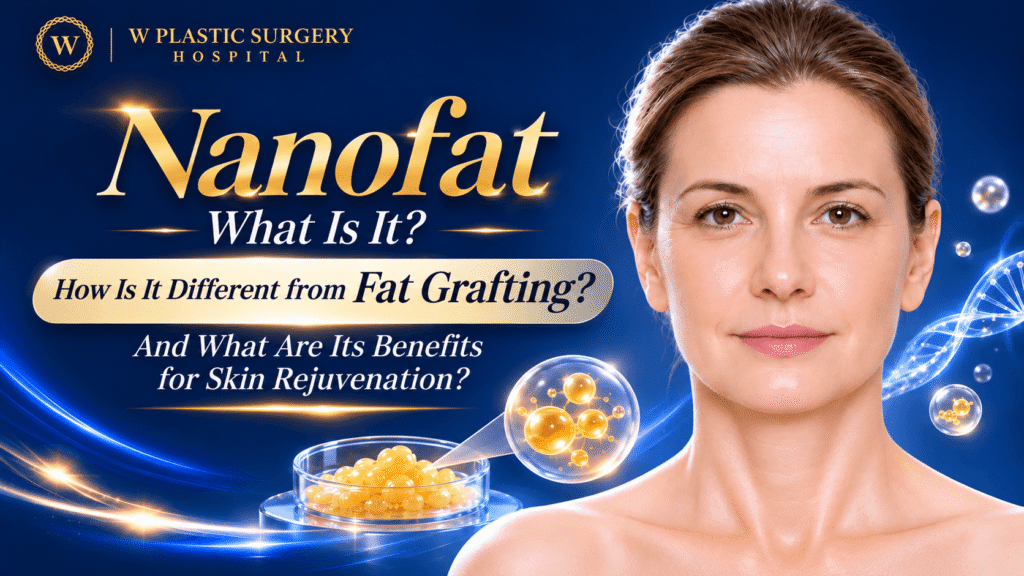
What Is Nanofat? An In-Depth Look at How It Differs from Standard Fat Grafting and a New Dimension in Cellular Skin Rejuvenation
When it comes to fat injections for restoring a youthful look, many people are familiar with the term Fat Grafting, or adding fat to restore fullness in hollowed areas. But today’s aesthetic innovations have gone a step further with an advanced technique called“Nanofat”, which has revolutionized skin care and the treatment of fine wrinkles and shallow lines at a far more delicate, molecular level
A common question among people seeking skin rejuvenation is: what is Nanofat, how does it work, and how is it different from traditional Fat Grafting? This article takes an in-depth look at the medical science behind it to help you understand the differences, the benefits, and how to choose a treatment that truly addresses your skin concerns
Getting to Know Nanofat, a Fine-Particle Aesthetic Innovation
Nanofat is a technology that takes your own fat cells (Autologous Fat) from areas with excess fat, such as the abdomen or thighs, and puts them through screening, cleansing, and mechanical emulsification (breaking the fat down through several levels of special filters) until the large fat cells become a liquid fat tissue with nano-sized fine particles
The key to Nanofat is not injecting it to add volume or projection (Volume) like ordinary large-particle fat, but extracting the “biological treasure” hidden inside fat tissue, which is rich in specialized stem cells (Adipose-Derived Stem Cells: ASCs) and Growth Factors. These are used to stimulate skin-quality renewal, repair damaged skin cells, and powerfully stimulate new collagen production
Why Does Nanofat Focus on “Regenerating” Rather Than “Filling”?
Nanofat works differently from typical filling procedures because nano-sized fat cells lose the ability to grow into large fat-storing cells. What remains and works at full effectiveness are their regenerative properties (Regenerative Properties):
- Stimulating Fibroblast Activity (Fibroblast Activation): The growth factors in Nanofat stimulate the fiber-producing cells in the dermis to continuously produce more collagen and elastin
- Building New Blood Vessels (Angiogenesis): Helps restore blood circulation and the capillaries beneath the skin, so dull skin regains a healthy, rosy glow
- Repairing Skin Structure at the Cellular Level (Cellular Repair): Restores the environment around skin cells, helping fade accumulated dark spots and improving mild sagging so the skin becomes firm, tight, and smooth again
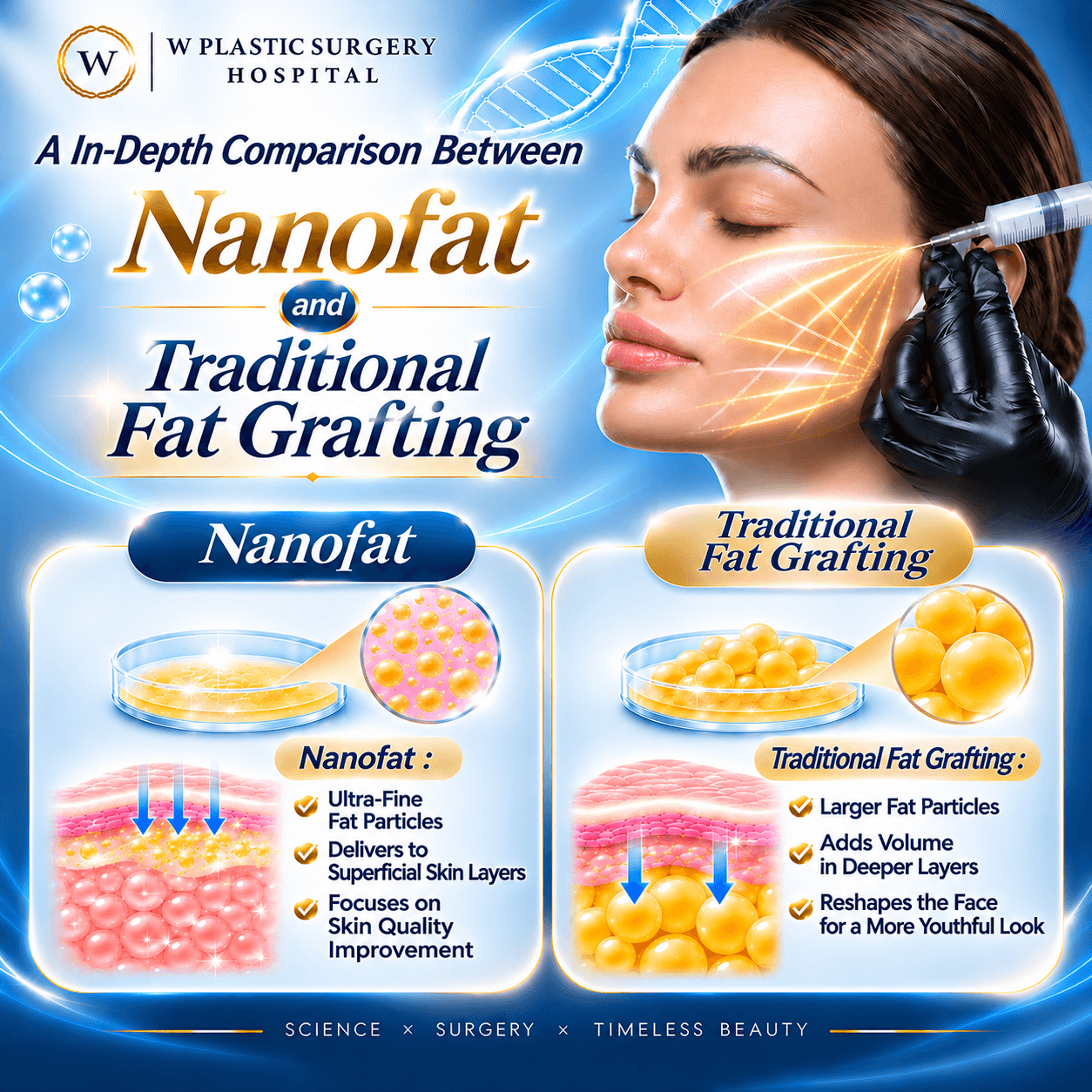
An In-Depth Look at the Differences Between Nanofat and Traditional Fat Grafting
Although both techniques use the patient’s own fat as the main material, their purposes and uses are completely different:
1. Particle Size and Injection Layer
- Traditional Fat Grafting (Macro/Micro Fat): Has large particles and is suited to filling the deep fat layer or the layer beneath the skin, to correct hollowed structures such as sunken temples, deep cheek grooves, or hollow cheeks
- Nanofat: Has the smallest, finest particles, filtered into a smooth liquid that can be injected superficially into the dermis (Intracutaneous) or into delicate areas that ordinary fillers cannot reach
2. Main Treatment Goals
- Fat Grafting: Focuses on facial contouring, filling in structure, and adding fullness so the face looks younger and well-proportioned
- Nanofat: Focuses on restoring skin quality (Skin Rejuvenation), treating fine wrinkles, shallow lines, and under-eye dark circles, and evening out skin tone
3. Results After Treatment
- Fat Grafting: Changes in contour and fullness are visible immediately after treatment
- Nanofat: The skin will not look raised right away, but you will gradually see improvements in skin quality, with skin that is firmer, tighter, more hydrated, and naturally younger-looking within 1-3 months
Which Areas Are Suitable for Nanofat?
Because its particles are so fine, Nanofat is well suited to treating delicate areas that require great precision, such as:
- Under-eye area: Helps with thin, translucent under-eye skin, visible veins, or chronic dark circles that are hard to treat
- Wrinkles around the eyes and lips: Helps fade fine lines (Fine Lines) caused by aging
- Scars and uneven skin: Helps stimulate healing and improves the skin in problem areas so it becomes smoother and more even
Premium Safety Standards and Care at W Plastic Surgery Hospital
Procedures that involve harvesting and processing fat cells, whether Fat Grafting or Nanofat, require advanced surgical expertise and a well-prepared facility. At W Plastic Surgery Hospital, we prioritize care at every step under premium hospital standards:
- Advanced fat cell processing technology: Performed through standardized sterile processes to preserve the integrity of the stem cells and growth factors for maximum effectiveness
- Personalized assessment and planning: A specialist surgeon carefully analyzes your skin and facial structure to choose the right technique, whether adding volume or regenerating with Nanofat
- Hospital-level safety standards: Every procedure is performed in a high-standard sterile room, with a specialist anesthesiologist providing close 1:1 care and essential medications such asDantrolene on hand for peace of mind in any situation
Talk with our team about Nanofat
Summary
Both Fat Grafting and Nanofat are innovations that harness the full potential of your own fat cells to restore a youthful look. Fat Grafting addresses structural filling and added volume, while Nanofat focuses on deep, cellular-level skin rejuvenation. Consulting a specialist doctor at W Plastic Surgery Hospital will help you receive the most appropriate and safest care
FAQ: Frequently Asked Questions About Nanofat and Fat Grafting
Q1: How is Nanofat different from regular fillers?
Nanofat uses your own purified fat cells, which contain stem cells that help restore skin quality over the long term, while fillers are synthetic substances (Hyaluronic Acid) that focus on filling deep lines and give immediate volume
Q2: Can Nanofat and Fat Grafting be done together in a single session?
They can be combined in many cases. The surgeon uses Fat Grafting to fill deep structures in hollowed areas and injects Nanofat superficially to rejuvenate the upper skin layers for smooth, radiant skin across the whole face
Q3: How much swelling and bruising is there after Nanofat, and how long is the recovery?
Because the needles used to inject Nanofat are very small, there is less swelling and bruising than with large-particle fat injections, and most people can return to their normal daily routine within a few days
Q4: How long do Nanofat results last?
The skin rejuvenation and newly stimulated collagen last quite a long time, since skin cells are repaired naturally from within. However, this depends on self-care and the natural aging process
Q5: Which areas are most commonly treated with Nanofat?
Popular areas with clearly visible results include dull or thin under-eye skin, shallow cheek grooves, wrinkles around the eyes, and areas where smoother, brighter skin is desired
Q6: Why can you feel confident about the safety of fat procedures at W Plastic Surgery Hospital?
Because we provide care under premium cosmetic surgery hospital standards, with procedures performed by specialist plastic surgeons, international-standard sterile operating rooms, 1:1 anesthesiologist care, and emergency life-saving medications such as Dantrolene fully on hand