091-774-6666
 @whospital

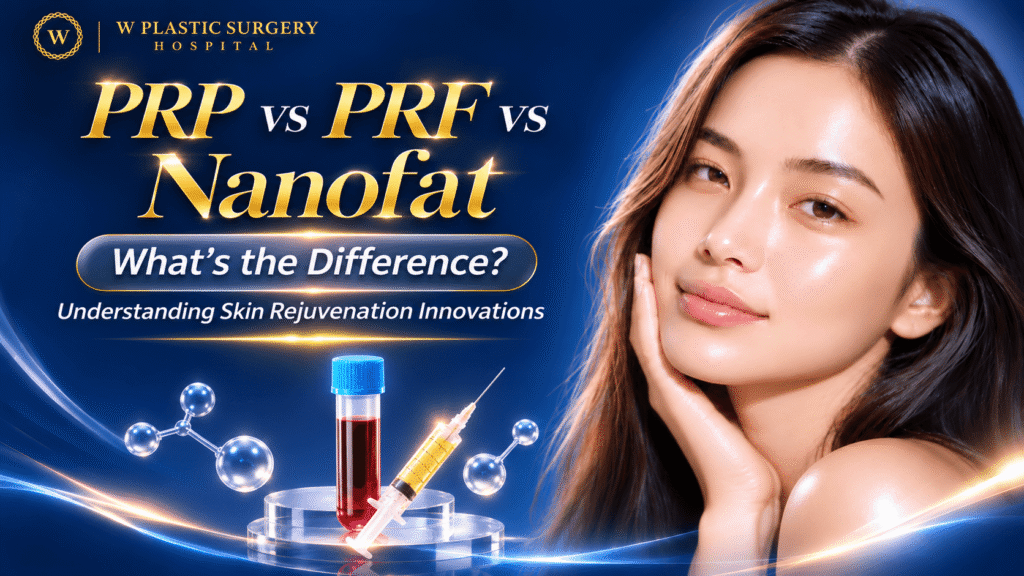
PRP vs PRF vs Nanofat: What's the Difference? Answering Your Questions About 3 Popular Cellular Skin Regeneration Innovations
As beauty trends move into the era ofRegenerative Aesthetics, or cellular-level regenerative aesthetics, using components from your own body to help repair and restore a youthful look has become a highly popular choice because it is very safe and lowers the risk of foreign substances. When it comes to this group of procedures, the namesPRP, PRF, and Nanofat often come up as top options, leaving many people wondering how these 3 are similar or different, and which one best addresses their own skin concerns
This article takes an in-depth look at the differences in their sources, how they work, and their results, so you can understand them and choose the right skin care approach
Getting to Know the Starting Point: Why Use Components from Your Own Body?
Before looking at the differences, what these 3 procedures have in common is the principle of regenerative medicine (Regenerative Medicine), which harnesses the human body’s natural repair power. It relies on Growth Factors and living cells to stimulate collagen production, repair damaged tissue, and restore skin quality from within. The difference lies in “the components used” and “the extraction process,” which directly affect how effective and long-lasting the results are
1. What Is PRP (Platelet-Rich Plasma)?
PRP, or platelet-rich plasma, is a technology that takes a small amount of the patient’s blood and spins it in a centrifuge (Centrifugation) to separate a plasma layer with a higher concentration of platelets than normal blood
- Main components: Platelets (Platelets) rich in Growth Factors such as PDGF, TGF-beta, and VEGF, in the form of a clear yellowish liquid
- Key benefits: Helps stimulate blood circulation, speed up wound healing, and restore overall skin condition for a brighter, more radiant look, while fading redness and acne marks
- Limitations: Because it is a clear liquid, the platelets release their Growth Factors fairly quickly, so results do not last very long, and there is no structure to support the tissue, so it cannot correct deep lines or sagging
2. What Is PRF (Platelet-Rich Fibrin)?
PRF is considered a more advanced evolution of PRP, developed to overcome the limitation of how quickly nutrients are released. The blood is spun at a lower speed and centrifugal force than PRP, so no anticoagulant (Anticoagulant) is needed
- Main components: Platelets, white blood cells, and a fibrin mesh (Fibrin Matrix) that come together to form a natural gel structure
- Key benefits: The fibrin mesh acts like a “time-release capsule,” holding Growth Factors and gradually releasing them to nourish the skin continuously for longer than PRP. It also contains white blood cells that help with immunity and better tissue repair
- Limitations: Although it has a fibrin structure for support, it is still not permanent tissue structure, so it focuses more on restoring skin quality and wound healing than on adding large amounts of volume
3. What Is Nanofat?
Nanofat moves beyond blood to use the patient’s own“purified fat cells”, which are screened and broken down with special instruments until they become a fine, nano-level liquid fat
- Main components: Specialized stem cells (Adipose-Derived Stem Cells: ASCs) and Growth Factors found within the fat tissue structure
- Key benefits: Has the highest concentration of stem cells of these 3 methods. It works to regenerate skin cells at a deep level, repair damaged skin structure, and effectively fill fine wrinkles and shallow lines or very thin skin areas (such as dark under-eye circles), while also giving longer-lasting results
- Limitations: Requires removing excess fat from the body (even if only a very small amount), so the process is more complex than a simple blood draw
Comparison Table: PRP vs PRF vs Nanofat
| Feature | PRP (Platelet Plasma) | PRF (Concentrated Platelet Fibrin) | Nanofat (Fine-Particle Fat) |
|---|---|---|---|
|
Source |
Patient’s blood |
Patient’s blood |
Patient’s fat cells |
|
Key components |
Platelets and Growth Factors in liquid |
Platelets, white blood cells, and fibrin mesh |
Fat-derived stem cells (ASCs) and Growth Factors |
|
Release process |
Fast release (works quickly but wears off fast) |
Gradual, continuous release (Long-lasting) |
Release plus long-term repair at the cellular level |
|
Main benefit |
Brightens skin and reduces acne marks |
Stimulates deep repair and excellent wound healing |
Restores skin quality and treats thin skin and fine lines |
|
Time to see results |
About 1-2 weeks |
About 2-4 weeks |
About 1-3 months (long-lasting results) |
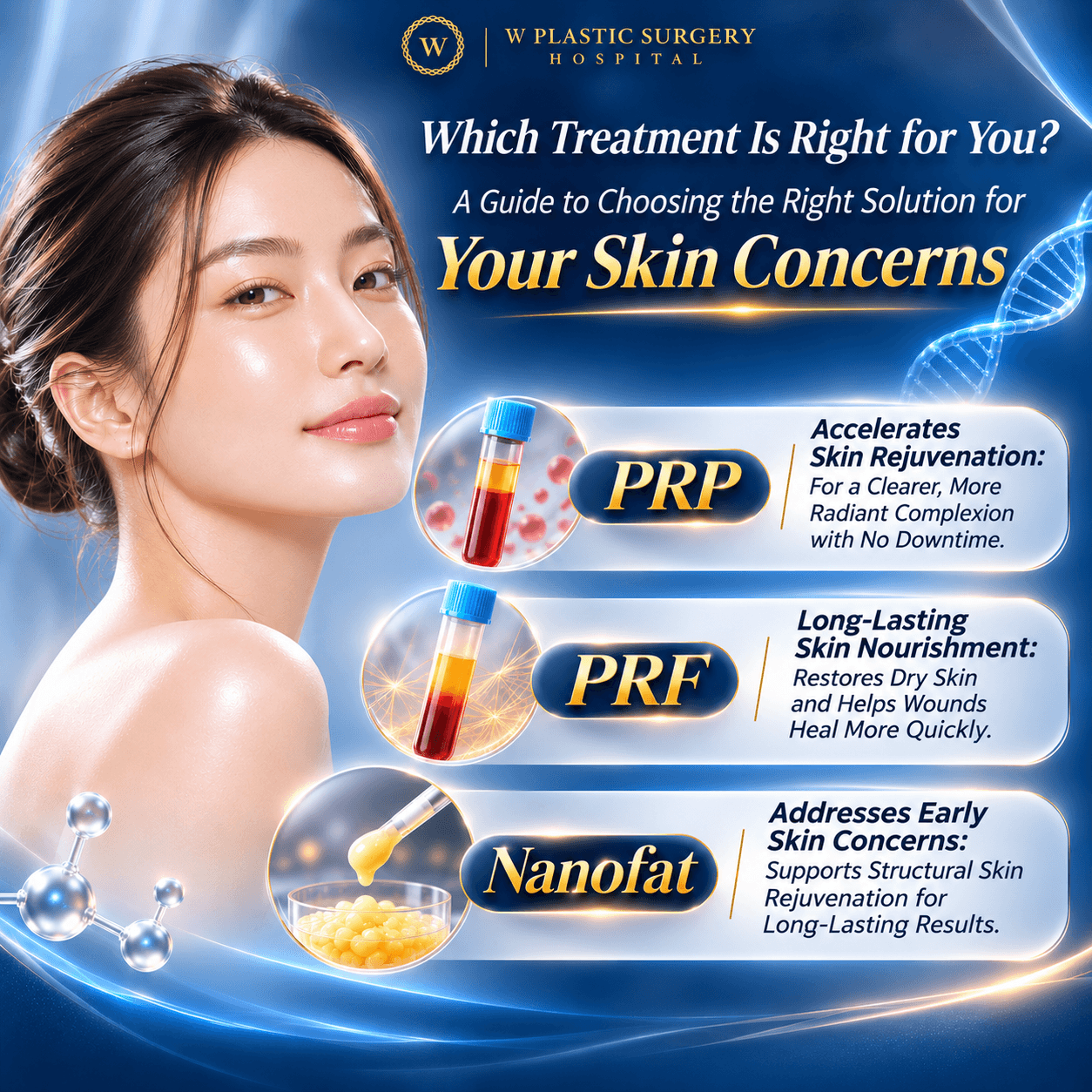
Which Option Is Right for You? Choosing Based on Your Skin Concerns
Choosing among these 3 options depends on each person’s needs and skin concerns:
- Choose PRP: If you want fast skin renewal, more radiance, less dullness, and no downtime
- Choose PRF: If you want longer-lasting nourishment, help restoring dry, rough skin, or faster wound healing after cosmetic surgery
- Choose Nanofat: If you have chronic thin skin (such as deep dark under-eye circles), fine wrinkles and shallow lines from aging, and want lasting, long-term restoration of skin structure
Confidence in Safety and Premium Results at W Plastic Surgery Hospital
Whether you are interested in skin regeneration using blood or fat cells, cleanliness, sterility, and the doctor’s expertise matter most. At W Plastic Surgery Hospital, we provide care under premium cosmetic surgery hospital standards:
- Precise assessment and analysis: A specialist doctor examines your skin and recommends the most suitable method for you, with no pressure to buy treatment packages
- Laboratory and sterile room standards: Blood and fat extracts are prepared with the utmost care, safely and free of contamination
- Maximum safety under hospital standards: Close care from our medical team and staff, with full life-support equipment, so you can enhance your looks safely and with confidence
Talk with our team about PRP, PRF, and Nanofat
Summary
PRP, PRF, and Nanofat are all skin regeneration innovations that use extracts from your own body, each with different strengths. Understanding the advantages of each method helps you choose an approach that targets your concerns precisely. A consultation with a specialist doctor at W Plastic Surgery Hospital will help design the most suitable skin care program to restore a youthful look and healthy skin for you in a lasting way
FAQ: Frequently Asked Questions About PRP, PRF, and Nanofat
Q1: How do PRP and PRF differ in how they work?
PRP releases Growth Factors immediately after injection, so brighter skin shows quickly but fades fairly fast. PRF has a fibrin mesh structure that holds and gradually releases nutrients to the skin, so the rejuvenation lasts longer
Q2: Between PRP and Nanofat, which is better for dark under-eye circles?
If dark circles are caused by pigment or mildly thin skin, PRP or PRF can help. But if the under-eye skin is very thin or there are also hollows, Nanofat is a better fit, because it provides stem cells to regenerate the skin and helps fill the skin structure so it looks thicker and smoother
Q3: Does the Nanofat procedure hurt, and how long is the recovery?
Nanofat involves harvesting fat cells (for example, from the abdomen or thighs), for which the doctor injects a local anesthetic, so you will not feel pain during the procedure. Afterward, there may be slight soreness at the harvest site and swelling at the injection area for about 3-5 days
Q4: Can PRP or PRF be done along with other cosmetic surgery?
Yes, they can be combined. Today, PRP or PRF is commonly used together with cosmetic surgery to help speed up wound healing, reduce swelling and bruising, and help incisions heal faster, under the doctor’s guidance
Q5: Are the results of these regenerative treatments permanent?
PRP and PRF provide temporary stimulation and should be repeated regularly to maintain the skin. With Nanofat, because fat cells and stem cells are transplanted, the cells that survive can stay with you for a long time, but natural aging still continues as you get older
Q6: Why choose W Plastic Surgery Hospital?
Because we provide care under premium cosmetic surgery hospital standards, with treatments performed by specialist doctors, laboratories and operating rooms that meet the highest safety standards, and close care for you at every step