091-774-6666
  @whospital

What Is a Deep Plane Facelift? A Facelift Technique That Helps the Face Look Naturally Firm
When talking about facelifts, many people may have heard the term “Deep Plane Facelift” before but still do not understand how it actually differs from a general facelift or who it is suitable for. This article will explain facial structure and the Deep Plane Facelift technique in detail before you decide whether this is the right technique for you.
First, Let Us Understand Facial Structure
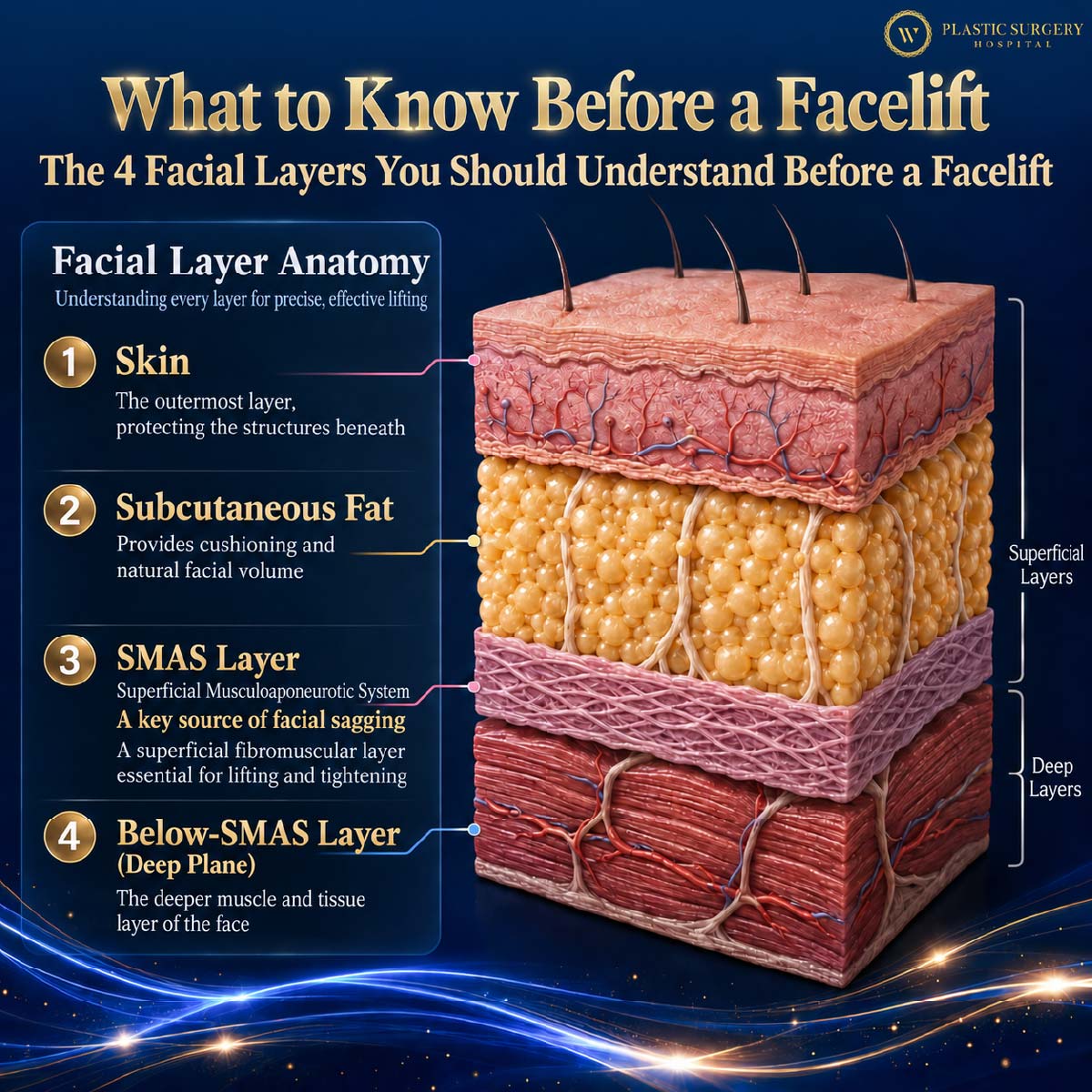
The human face does not consist only of skin and bone. There are several structural layers, and each layer plays a different role in sagging.
Skin layer (Skin): The outermost visible layer. As we age, it loses elasticity.
Subcutaneous fat layer (Subcutaneous Fat): A thin layer of fat that helps the face look full. When it sags, it can create nasolabial folds and make the facial contour less clearly defined.
SMAS layer (Superficial Musculoaponeurotic System): A layer of fascia and muscle beneath the fat. It is connected with facial movements such as smiling or moving the mouth and is a main underlying cause of true sagging.
Deep layer beneath the SMAS (Deep Plane): A layer deeper than the SMAS that includes important structures such as facial nerves and deep cheek fat.
Understanding each of these layers is what determines what kind of result a facelift can produce.
What Is a Deep Plane Facelift?
A Deep Plane Facelift is a facelift technique that works directly in the layer beneath the SMAS, rather than correcting only the skin layer or lifting the SMAS separately from the skin. This technique lifts the facial structure — skin, fat, and SMAS — together as one unit (En Bloc), allowing the lifting force to be distributed naturally rather than concentrated in one area.
The important differences compared with a general SMAS facelift are:
General SMAS Facelift: The skin layer and SMAS layer are lifted separately. It can provide good tightening, but in some cases the skin may need to be pulled further to achieve the desired result.
Deep Plane Facelift: The entire structural unit is lifted together. This helps correct deeper areas, such as deep nasolabial folds and significant sagging of the facial contour, effectively without having to pull the skin excessively tight.
Who Is a Deep Plane Facelift Suitable For?
Because it works more deeply than a general facelift, a Deep Plane Facelift is not necessarily suitable for everyone. It may be especially worthwhile for patients with the following characteristics:
1. Moderate to Significant Sagging
It is suitable for patients with clearly deep nasolabial folds, sagging of the facial contour that creates jowls, or those who have previously had a facelift using another technique but found the result did not last as long as expected.
2. Wanting a Natural-Looking Result Over the Long Term
Because the lifting force is distributed evenly across the facial structure, results from a Deep Plane Facelift often look natural and can last longer.
3. Wanting to Avoid an Unnaturally Tight Appearance
Because the technique does not rely on pulling the skin excessively tight, it can better help reduce the risk of an unnaturally tight appearance.
Why Understanding Facial Structure Is Important Before Choosing a Technique
Choosing a suitable facelift technique should not be based only on a technique name that sounds advanced. You should first understand which layer is responsible for your own sagging, because each technique is suited to different situations. A detailed facial assessment by a specialist is therefore the most important step before planning which technique is most suitable for each patient.
W Plastic Surgery Hospital and Expertise in Deep Plane Facelift
Performing a Deep Plane Facelift requires expertise and a deep understanding of facial anatomy because the technique works close to the facial nerves. Our specialist surgical team therefore places importance on a detailed facial assessment in every case in order to plan the most suitable technique, together with hospital-level safety standards throughout surgery. If you are considering a Deep Plane Facelift and want to understand whether this technique is suitable for you, we are ready to provide a detailed consultation.
For more information
FAQ: Frequently Asked Questions
Q1: How is a Deep Plane Facelift different from an SMAS Facelift?
An SMAS Facelift lifts the skin and SMAS layers separately, while a Deep Plane Facelift lifts the skin, fat, and SMAS together as one unit. This allows the lifting force to be distributed more naturally and is suitable for cases with moderate to significant sagging.
Q2: Is a Deep Plane Facelift more dangerous than other facelift techniques?
Because this technique works close to the facial nerves, it requires a doctor with a high level of expertise and experience specifically in performing this procedure. It is therefore important to choose a specialist medical team in a medical facility that meets appropriate standards in order to maximize safety.
Q3: How long do the results of a Deep Plane Facelift last?
In general, the results of a Deep Plane Facelift often last longer than those of a traditional facelift because the technique corrects deeper structures and distributes the lifting force evenly. However, the exact duration depends on each person’s skin condition and self-care.
Q4: How do I know whether a Deep Plane Facelift or another technique is suitable for me?
You should receive a detailed facial assessment from a specialist to determine which layer your sagging comes from and how severe it is. The doctor will recommend the technique most suitable specifically for the condition of your face.
Q5: Does recovery after a Deep Plane Facelift take a long time?
Because the technique works more deeply than a general facelift, recovery time may vary from person to person. You should follow the doctor’s instructions strictly and attend follow-up appointments so that the wound heals well and the result is as complete as possible.