091-774-6666
 @whospital


Grooves Forming and a Dull Face After Weight Loss: Should You Choose a Facelift or Fat Grafting?
Successfully losing weight is cause for celebration, as it gives you a slimmer figure and better health. But many people face a new worry when they look in the mirror and find that the face has begun to look sunken, with clearly visible deep grooves, hollow under-eyes, deflated cheeks, or a worn, dull appearance. Even though the body is slimmer, the face looks older than before, and confidence suffers.
A sunken face with deep grooves after weight loss results from the loss of fat volume beneath the skin (Volume Loss) and the sagging of the internal structures. When it comes to deciding on a solution, many people hesitate between aFacelift andFat Grafting, unsure which is the right answer that best addresses their own problem. This article helps you understand the differences between the two methods so you can make the right decision about how to restore your facial structure.
Why Does the Face Become Sunken, Grooved, and Dull After Weight Loss?
Before choosing between a Facelift and Fat Grafting, let’s first understand what happens to our face after weight loss.
When the body burns stored fat to lose weight, that fat does not shrink only in the belly or thighs. The layer of fat beneath the skin across the entire face deflates as well, like a cushion of firmness that has gone flat. The once-full skin loses its support, resulting in hollowness and a sunken look at the temples, cheeks, and under the eyes. In addition, the retaining ligaments that were once taut begin to slacken under gravity, inevitably leading to deep nasolabial folds and drooping corners of the mouth.
A Deep Dive into Fat Grafting (Facial Fat Transfer): The Option for a Sunken Face That Has Lost Its Definition
Facial fat grafting, or Fat Grafting, takes excess fat cells from another area of the body, such as the abdomen or thighs, and processes them through filtering and purification to obtain pure, high-quality fat cells, which are then injected to fill the sunken areas or deep grooves of the face.
Key Advantages and Benefits of Fat Grafting:
- Highly Natural Results: Because the fat comes from your own body, there is no risk of allergy or rejection, and the texture and softness after treatment look very natural.
- Restores Fullness to the Face: Ideal for those with a sunken face, hollow cheeks, deep temples, or deep-set, hollow eye sockets from weight loss, as it restores volume so the face looks plump and youthful again.
- Helps Rejuvenate Skin Quality: Fat cells also contain naturally occurring stem cells, which help the skin in the treated area look brighter and more elastic.
Who Is It For?
- Those who have lost weight and now have a sunken face, deflated cheeks, and a gaunt-looking facial structure, but whose skin still has good elasticity without severe sagging.
- Those who want to add soft, dimensional fullness to the face without using foreign synthetic substances.
A Deep Dive into the Facelift: The Option for Sagging Skin and Excess Tissue
A Facelift is not simply pulling the outer skin tight. It is surgery that corrects the internal structure at a deep level, especially the deep-plane technique (SMAS Facelift), in which the surgeon lifts and tightens the deep muscle layer, repositions the sagging tissue, and meticulously trims away excess skin.
Key Advantages and Benefits of a Facelift:
- Addresses the Root Cause: Decisively resolves the sagging of muscle and skin that has dropped under gravity.
- Restores a Defined Jawline: Tightens the tissue along the jaw and neck, eliminating a double chin and clearly correcting drooping, sagging cheeks.
- Long-Lasting Results: Delivers the most permanent and longest-lasting results compared with other procedures.
Who Is It For?
- Those who have lost a great deal of weight, to the point where the skin has lost its elasticity, resulting in sagging, drooping cheeks, or substantial excess tissue along the jawline.
- Those aged 35 and over who also have sagging, where fat grafting alone cannot resolve the excess skin.
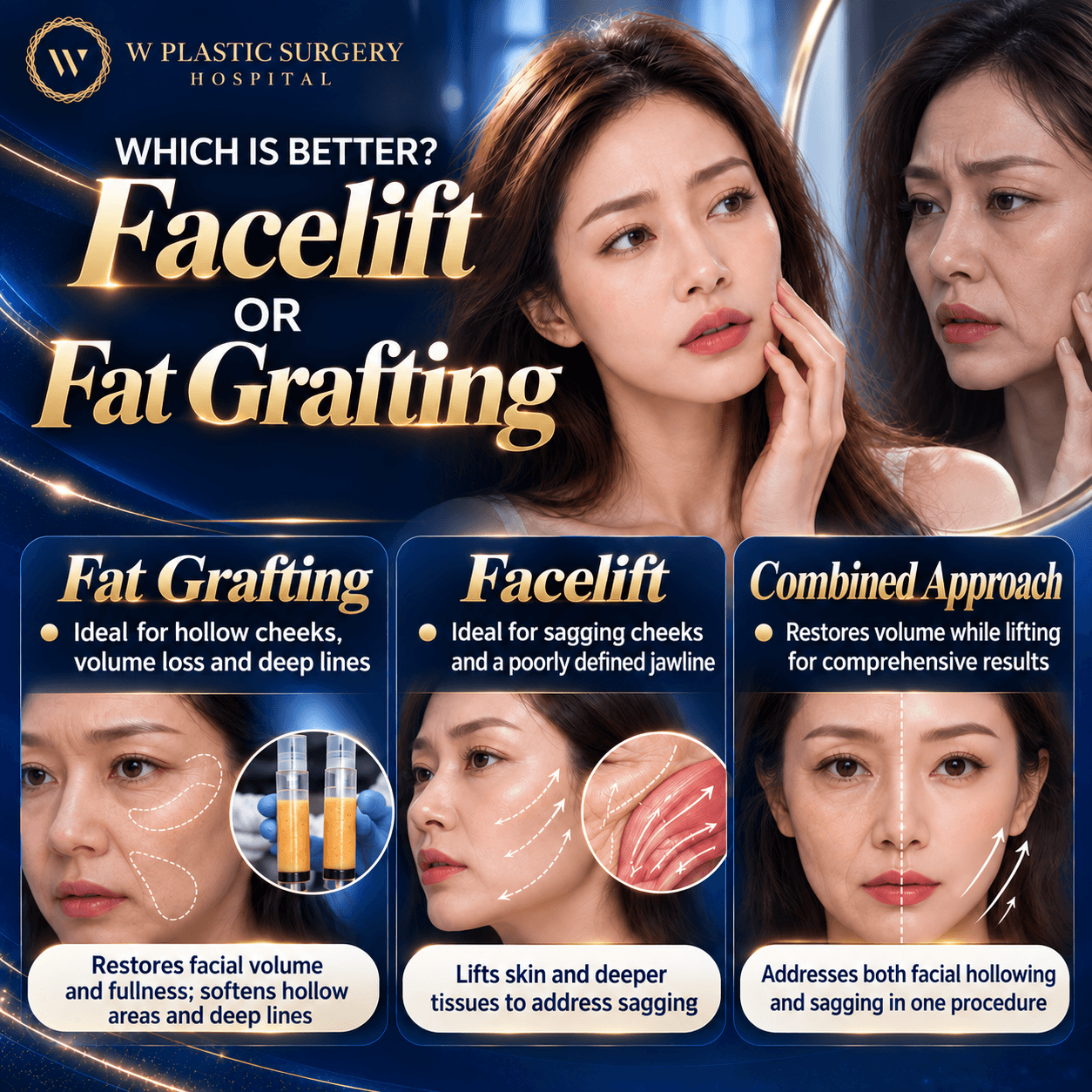
A Clear Side-by-Side Summary: Which Is Better, Facelift or Fat Grafting?
- Choose Fat Grafting: If your main problem is“a sunken face, hollow skin, deflated cheeks, and deep grooves” but your skin is still firm and not sagging or drooping, fat grafting will restore fullness and make your face look younger and fresher.
- Choose a Facelift: If your main problem is“sagging, drooping cheeks, an undefined jawline, and excess skin,” a facelift will lift and tighten the structure precisely where it is needed.
- They Can Be Combined: In many cases where someone has lost weight and has both a sunken face and sagging skin, the surgeon may recommend doing both together (for example, a facelift to address the sagging combined with fat grafting to make the face look full and dimensional) for the most complete results.
Confidence in Safety and Harmonious Results at W Plastic Surgery Hospital
Whether you are a candidate for a Facelift or Fat Grafting, choosing an accredited facility is the single most important factor in helping you transition safely to your best version. AtW Plastic Surgery Hospital, we are ready to care for you with premium standards:
- Individualized Problem Analysis: Our team of specialist surgeons carefully evaluates your facial structure, fat volume, and degree of skin sagging to recommend the treatment approach that best meets your needs, without selling unnecessary treatment packages.
- Advanced Medical Techniques: Whether it is the deep-plane facelift (SMAS Facelift) with discreetly hidden incisions, or fat extraction and transfer using specialized techniques that increase the fat survival rate, the results are soft and natural-looking.
- The Highest Safety Standards: Every procedure and surgical case is performed in a hospital-standard sterile operating room, with a dedicated anesthesiology team providing close 1:1 care at all times, and emergency life-saving medication such asDantrolene on hand for worry-free safety at every step.
Talk with our team about facelift and fat grafting
Conclusion
A sunken face, deep grooves, and a dull look after weight loss can be corrected to look good and youthful again once you understand your true underlying problem. Choosing between a Facelift and Fat Grafting depends on each individual’s skin condition and degree of sagging. Let the team of specialist physicians at W Plastic Surgery Hospital design the right approach for you, to restore your confidence and your bright smile once again.
FAQ: Frequently Asked Questions About Correcting a Sunken, Sagging Face
Q1: If I have both a sunken face and drooping cheeks after weight loss, can I have a Facelift and Fat Grafting at the same time?
Yes, they can be done together, and this is a very popular approach among people who have lost a lot of weight. The facelift tightens the sagging areas back into place, while the fat grafting fills the hollow, sunken areas to restore fullness, so the face looks younger and fresher, all in a single session.
Q2: Is facial Fat Grafting permanent, or how often does it need to be repeated?
The fat cells that take and develop a blood supply (generally about 50–70% after the first 3 months) remain permanently and become your own tissue. If your weight stays stable, the restored fullness lasts for many years without the need for frequent touch-ups.
Q3: Is Facelift surgery very painful, and how long is the recovery?
During surgery you are under the care of an anesthesiologist, so you feel no pain. Afterward, there is swelling and tightness during the first week. The incisions are discreetly hidden along the hairline and behind the ears, and most patients see the swelling subside and can return to their normal life or work within 2 weeks.
Q4: If I am still fairly young (early 30s) but have a sunken, sagging face after weight loss, which option should I choose?
In your early 30s, if your skin still has good elasticity, the problem usually lies in the deflation of fat. Fat Grafting, or a lifting procedure combined with volume restoration, is usually a better fit than major surgery. That said, a physician should evaluate you in person to ensure the most targeted results.
Q5: How does filler injection differ from Fat Grafting for correcting a sunken face?
Filler is a synthetic volumizing substance that gives immediate results, is convenient, and requires no downtime, but it gradually breaks down naturally within 1–2 years. Fat Grafting uses your own fat cells. Although there is a recovery period and some of the fat is absorbed early on, the portion that takes is permanent and feels more natural.
Q6: Why is choosing a surgical hospital with an anesthesiologist so important for major surgery?
Because general anesthesia for major surgery requires a specialist to continuously and closely monitor breathing and vital signs. Having a dedicated anesthesiologist providing 1:1 care ensures the highest level of safety and readiness to respond promptly to any complication that may arise.